
Predictive Dialer vs Power Dialer
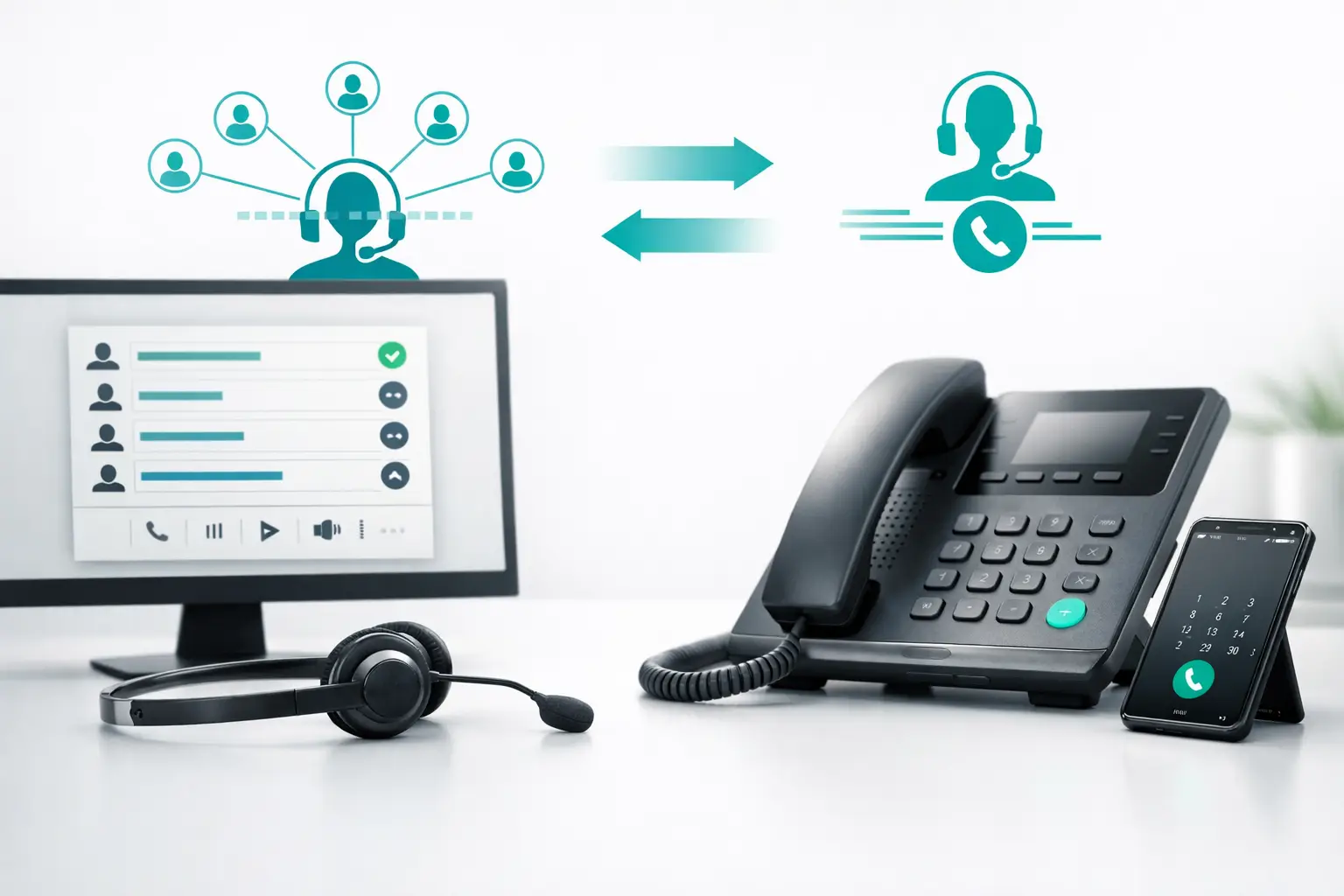
If your outbound team is losing time between calls, the question is usually not whether to automate dialing. It is which dialing model fits the operation you actually run. In the predictive dialer vs power dialer decision, the wrong choice creates a familiar mess - idle agents, dropped handoffs, uneven lead handling, and reporting that hides the real problem.
This is not a feature comparison for small differences. These two systems shape pacing, staffing, answer handling, and customer experience in very different ways. For operators running revenue teams, appointment-setting programs, or AI voice campaigns, that distinction matters fast.
Predictive dialer vs power dialer: the core difference
A power dialer places one call at a time for each available agent, usually moving to the next record as soon as the current call ends or is dispositioned. The pacing is controlled and sequential. An agent is typically connected only after the call is answered, but the system is not aggressively over-dialing to predict agent availability.
A predictive dialer is built for volume. It uses historical pickup rates, call duration, abandonment patterns, and agent availability to place multiple calls ahead of time. The system predicts when an agent will be free and tries to have a live answer waiting. When it works well, agent talk time goes up because less time is spent listening to rings, voicemails, and no-answers.
That difference sounds simple. Operationally, it changes almost everything.
When a power dialer is the better fit
A power dialer works best when call quality matters more than absolute call throughput. If your reps need a moment to review a record before each call, personalize the opener, or follow a compliance-sensitive workflow, power dialing gives you control that predictive systems often reduce.
This is common in insurance, mortgage, real estate, and high-consideration home services. The lead value is high. Conversations are more nuanced. Reps often need context from the CRM, prior SMS replies, past appointment history, or enrichment data before speaking.
Power dialing also fits teams with smaller agent counts. If you have five reps, not fifty, the efficiency gains from predictive pacing can be less dramatic than the operational risk. A single misconfigured predictive campaign can create poor handoffs quickly. With a power dialer, the relationship between available agents and calls placed is easier to manage.
It is also a strong fit for AI-assisted outbound programs where the workflow includes branching logic, human handoff conditions, or follow-up sequences across voice, SMS, and email. In those environments, the call is only one step in a broader sequence. You want controlled progression, clean dispositions, and reliable sync back to the CRM.
When a predictive dialer is the better fit
Predictive dialing is built for high-volume teams with enough live capacity to absorb variable answer rates. If your operation has a large agent pool, standardized call handling, and a campaign where speed matters, predictive dialing can materially increase utilization.
This is where inside sales teams, appointment centers, and larger outbound programs often benefit. If reps are working broad lead lists, the script is consistent, and every minute of idle time is expensive, predictive dialing pushes more live conversations per hour.
The trade-off is that predictive performance depends on good inputs. You need stable carrier performance, usable answer-rate history, clear campaign rules, and reliable visibility into how many agents are actually available. If those conditions are weak, the model gets unstable. Calls can connect before an agent is ready, abandoned-call risk increases, and customer experience degrades.
Predictive systems are less forgiving of fragmented infrastructure. If your dialer, carrier, CRM, AI voice stack, and reporting layer all live in separate tools with inconsistent status updates, the predictive model is making decisions on stale data.
The real trade-off: efficiency vs control
Most teams frame predictive dialer vs power dialer as a speed question. That is incomplete. The real choice is efficiency versus control.
Power dialing gives supervisors tighter operational control. You can pace outreach more deliberately, align call timing with lead priority, and make sure each record gets the right treatment. It is easier to troubleshoot because the workflow is simpler. If performance drops, you can usually isolate whether the issue is data quality, script quality, rep behavior, or answer rates.
Predictive dialing shifts the center of gravity toward system optimization. It can produce more talk time and more attempts, but only if the campaign is tuned correctly. That means list hygiene, disposition discipline, staffing consistency, carrier quality, and reporting accuracy all matter more. The upside is higher throughput. The downside is more sensitivity to operational gaps.
For serious operators, this is why the dialer decision should never be made in isolation. Dialing mode is downstream from the rest of the calling stack.
AI voice changes the conversation
AI voice agents complicate the old predictive-versus-power framework in a useful way. Human agents need recovery time, coaching, and schedule management. AI agents do not. That changes what utilization means.
If an AI agent is handling the first touch, qualifying the lead, or booking appointments directly, predictive logic can scale far more aggressively than in a human-only environment. But that does not mean predictive is automatically the right answer. It means you need tighter orchestration around when the AI calls, what happens when a live transfer is needed, how retries are sequenced, and how outcomes get written back into the system.
For example, a solar operator running AI outreach may want aggressive first-pass dialing during a narrow answer-rate window, then slower follow-up cadences across SMS and voicemail drops where appropriate and compliant. A power-style workflow may be better for warm leads that need contextual handling, while a predictive-style workflow may be right for broad reactivation campaigns with clear qualification criteria.
This is where infrastructure matters more than the dialer label. The best-performing teams do not ask for one universal dialing mode. They ask for campaign-level control.
What to evaluate before you choose
The right dialer depends on four operational variables.
First is lead value. If each conversation is expensive to generate and has meaningful revenue potential, slower pacing with better context often wins. Second is agent structure. Small teams and blended teams usually benefit from more controlled dialing, while larger dedicated outbound teams can justify predictive pacing.
Third is workflow complexity. If the call is part of a multi-step sequence with CRM sync, appointment logic, AI qualification, and human escalation, you need a dialing setup that does not break the downstream process. Fourth is data quality. Predictive systems rely on accurate statuses, dispositions, and availability signals. If your stack is fragmented, the dialer will magnify the problem rather than solve it.
A practical test is to look at your current failure mode. If reps are sitting idle between good leads, predictive may help. If your bigger issue is messy handoffs, poor list treatment, inconsistent dispositions, or weak visibility across systems, power dialing is often the safer base layer.
Why many teams end up needing both
For growing outbound operations, predictive dialer vs power dialer is often the wrong final question. The better question is where each mode belongs.
Different campaigns need different pacing models. New lead intake may need immediate, high-volume response. Aged leads may require controlled retries and channel switching. High-intent inbound callbacks may need strict prioritization and fast routing to the right queue. Renewal, cross-sell, and reactivation motions each behave differently.
Teams that mature past basic dialers usually stop treating dialing as a standalone tool. They treat it as one control inside a larger operating system that includes routing, CRM sync, channel sequencing, reporting, number management, and failover. That is especially true when AI voice agents and human reps share the same pipeline.
This is one reason infrastructure platforms like VoiceUni are gaining traction with operators already using tools such as Vapi, Retell, Twilio, HubSpot, or Salesforce. The issue is rarely a lack of dialing options. The issue is coordinating dialing logic with the rest of the workflow without creating brittle point-to-point integrations.
How to make the decision without guessing
Run the decision through actual campaign math, not vendor claims. Measure connection rate, live-answer rate, average handle time, after-call work time, transfer rate, appointment rate, and agent occupancy. Then model what happens if you increase pacing. If your downstream process cannot absorb more live conversations cleanly, higher dial speed will not create better outcomes.
It also helps to segment by campaign intent instead of buying one dialer philosophy for the whole business. Your lead gen team, follow-up team, and inbound conversion team may need different dialing behavior even if they work from the same data stack.
A good outbound operation is not defined by how fast it dials. It is defined by how reliably it converts effort into conversations, conversations into outcomes, and outcomes into clean data for the next touch.
If you are choosing between the two, start with the workflow you need to run tomorrow morning, not the feature set that looks best in a demo.
More from the VoiceUni Blog.

What Drives Solar Appointment Booking Results
A solar operator booking 150-plus appointments in a single week is not winning because it found a magic script. It is winning because its lead response, qualification, routing, follow-up, and reporting are operating as one system. Solar appointment booking results are usually decided in the handoffs between those st...

AI Phone Number Reputation Guide for Call Teams
A campaign can have clean data, a capable AI voice agent, and a well-built follow-up sequence, yet still underperform for one basic reason: the originating phone number has lost trust. This AI phone number reputation guide is for operators who need to protect answer rates before poor number health turns into a pipel...

AI Contact Center Software Review for Operators
An AI contact center software review should start where most evaluations fail: the live workflow, not the demo. A voice agent that can hold a convincing conversation is only one component. Revenue operations still need the right lead data, approved contact rules, routing logic, carrier capacity, CRM updates, human e...
Get new posts by email.
One email a month, no spam, unsubscribe anytime.