
Why Use AI Call Routing for Revenue Teams?
A homeowner calls after seeing an ad, asks whether a technician can visit this week, and is ready to book. If that call lands in a generic queue, reaches an unavailable rep, or gets transferred twice, the lead cools before anyone can act. This is why use AI call routing is an operational question, not a feature comparison. The routing decision determines whether a live conversation becomes a booked appointment, a qualified opportunity, or another missed call in a dashboard.
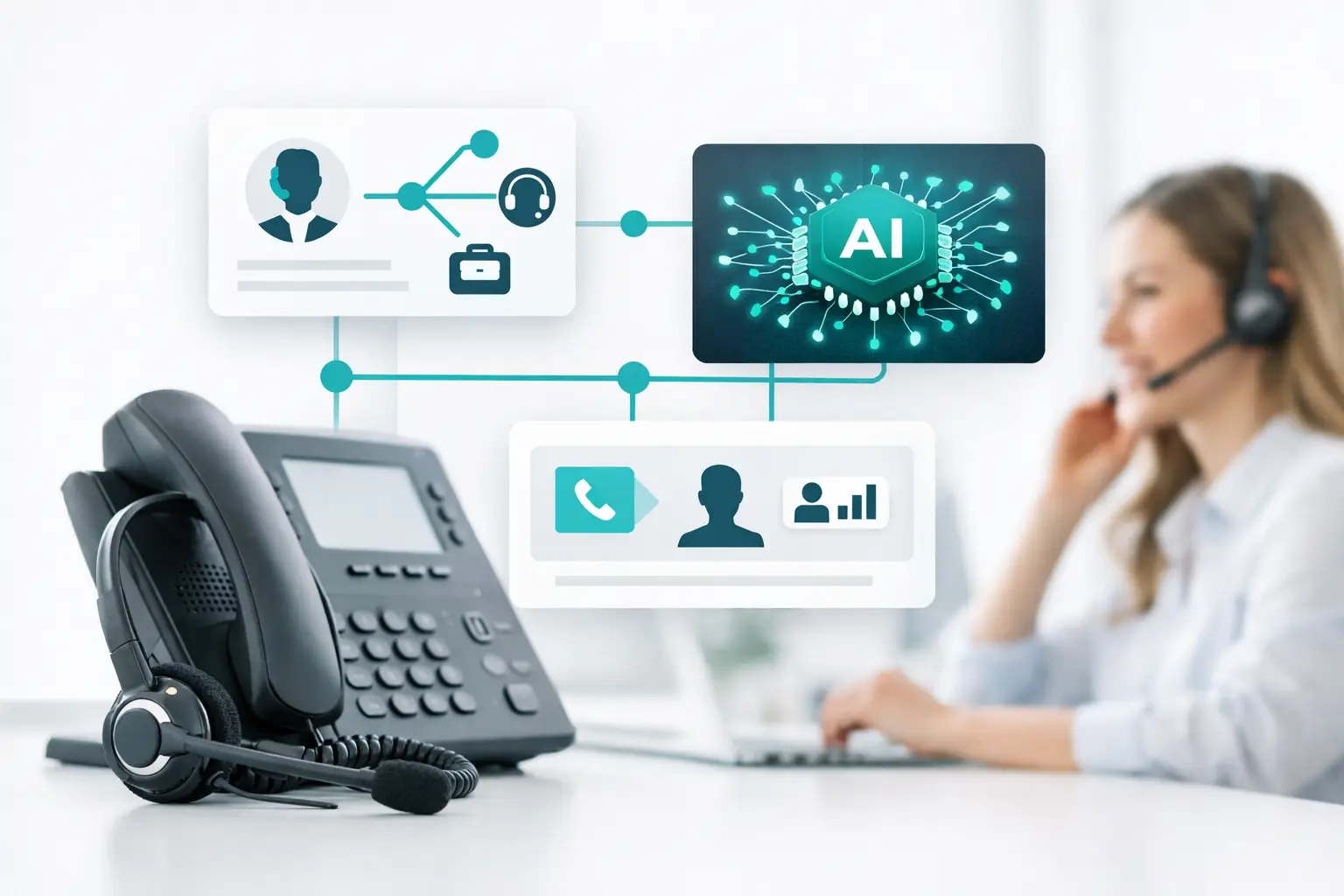
Traditional phone trees route based on a button press or a static department rule. AI call routing uses live conversation context, customer data, business rules, agent capacity, and channel history to decide what should happen next. It can send the caller to an AI voice agent, a specific human team, an on-call field rep, a priority queue, or a follow-up workflow.
For revenue teams that rely on calls, the difference is material. More lead sources, more campaigns, and more AI agents create more routing decisions. Without a control layer, those decisions become a collection of brittle carrier settings, CRM automations, and one-off handoff logic that is difficult to test and even harder to diagnose.
Why Use AI Call Routing Instead of Static Queues?
Static queues assume every call in a category deserves the same path. Production call operations rarely work that way. A new solar lead calling after requesting a quote should not follow the same route as an existing customer checking an installation date. A high-intent mortgage prospect who has already completed an application should not wait behind a general inquiry. A customer who has called twice in an hour may need escalation, not another intake script.
AI routing evaluates signals that static queues generally ignore. Those signals can include the caller's stated intent, CRM lifecycle stage, campaign source, location, language preference, prior call outcome, open ticket status, current agent availability, and time of day. The result is a decision based on the value and context of the conversation rather than only the phone number dialed.
That does not mean every route should be dynamic. Some rules should remain fixed. Emergency support lines, regulated escalation paths, and clearly defined account queues need predictable handling. The goal is not to replace deterministic rules with opaque automation. It is to apply intelligence where context improves the outcome and preserve hard rules where consistency matters most.
Route by intent, not just department
Intent is often the most useful routing signal because callers do not organize their needs around internal org charts. They say, "I need an estimate," "My policy is expiring," or "I need to reschedule." An AI agent can identify the request, gather the minimum required information, and route the conversation to the workflow built for that outcome.
For a home services operator, a repair request may go to the dispatch queue while a new installation inquiry goes to sales. For an insurance agency, an existing policyholder may go to service while a caller requesting a new quote enters a qualification workflow. The routing logic should reflect the commercial process, not the limitations of the PBX menu.
Protect high-value calls from queue decay
Every transfer and hold event adds friction. It also obscures accountability. When a lead abandons after three transfers, the call center may show an answered call while the revenue team sees no appointment and no clear reason why.
AI call routing can prioritize calls using lead score, source, stated urgency, or known account value. It can reserve human capacity for conversations where a person materially improves conversion, while AI handles repeatable intake, qualification, scheduling, and status requests. That is not about removing people from the process. It is about making sure skilled people receive the calls that need them.
The Operational Benefits of AI Call Routing
The strongest case for AI call routing is not that it sounds more advanced. It is that it creates a more controllable operation.
First, it reduces the gap between a conversation and the systems that need to act on it. When routing is connected to the CRM, a caller's record, lead source, owner, appointment history, and prior outcomes can inform the next action. The route can also update the record with disposition, transcript data, call outcome, and follow-up tasks. Teams stop asking whether the phone system and CRM are telling the same story.
Second, it improves coverage without forcing every call into a human queue. An AI receptionist can answer after hours, qualify an inquiry, schedule an appointment, or create a callback task with the right context. If the caller requires a person, the handoff should carry the reason for the call and the information already collected. Asking a caller to repeat everything after an AI interaction defeats the purpose of automation.
Third, it gives operators a way to manage exceptions. Carrier issues, unavailable teams, overflowing queues, and failed transfers are not edge cases in a growing call operation. They are expected conditions. A well-designed routing plan includes alternate paths: another qualified queue, a callback workflow, an alternate carrier route, or a channel shift when appropriate. Failover is a revenue protection mechanism, not a telecom detail.
Finally, it makes performance measurable. A routing system should show where calls entered, why they were routed, where they landed, whether the transfer completed, how long the caller waited, and what happened next. Without that visibility, teams can measure volume but cannot improve the call journey.
What Good AI Call Routing Looks Like in Practice
A practical implementation starts with a small number of high-value call journeys. Trying to automate every edge case on day one usually creates confusion. Start where poor routing is already expensive: new lead intake, appointment booking, inbound sales, urgent support, and human escalation.
Consider a real estate team running paid lead campaigns. A new inquiry calls from a tracked campaign number. The routing layer recognizes the source, checks whether the lead exists in the CRM, and lets an AI agent confirm property interest, timeline, and financing status. If the lead is ready to speak with an agent, the system routes to the assigned rep if available, then to a qualified backup queue if not. If no one can take the call, it schedules a callback and records the context.
The same approach works for an agency managing multiple clients. Each inbound number can map to a separate brand, campaign, AI agent, routing policy, and CRM destination without requiring a separate collection of custom integrations. The agency can operate a consistent framework while preserving each client's business rules.
For customer support, routing may depend more heavily on account status and issue type. A caller with an open service ticket should not be pushed through a new-customer qualification flow. An AI agent can identify the account, summarize the issue, check for relevant ticket context, and send the call to the correct service team. If the request is straightforward, it may resolve the issue without a transfer at all.
The Infrastructure Behind Reliable Routing
Routing quality depends on the systems around it. An AI voice agent can understand the caller, but it cannot deliver a reliable operation if the telephony, CRM, availability data, and handoff workflows are disconnected.
That is why routing should sit in an orchestration layer rather than inside a single AI agent or carrier configuration. The routing layer needs to coordinate phone numbers, carriers, AI providers, CRM records, campaign data, agent status, reporting, and fallback logic. It also needs to support change without a developer rebuilding the workflow each time a team adds a campaign or changes ownership rules.
VoiceUni is designed for this operational layer. Businesses can keep their existing AI voice provider, carrier, numbers, CRM, and data sources while managing routing, handoffs, campaigns, and reporting in one environment. That matters when the business is already using tools such as Vapi, Retell, Twilio, HubSpot, Salesforce, Apollo, or GoHighLevel and does not want its call operation held together by fragile middleware.
The same principle applies across channels. A call may begin on voice but require a confirmed appointment by SMS, a follow-up email, or a webchat conversation with the same lead record. Routing should preserve context across those touchpoints instead of treating each channel as a separate operation.
Where AI Call Routing Can Go Wrong
AI routing is not automatically better because AI is involved. Poorly defined intent categories, incomplete CRM data, and unclear escalation rules can create faster versions of existing problems. If a team cannot explain who owns a lead after a transfer fails, automation will not solve the ownership gap.
Over-automation is another common mistake. Some callers need a person immediately, especially when the issue is complex, sensitive, or high value. Build explicit human handoff rules and measure whether handoffs connect successfully. A transfer that rings without an answer is not a successful escalation.
Teams should also avoid treating routing logic as a one-time configuration project. Campaigns change, staffing changes, and lead quality changes. Review routing outcomes regularly: transfer completion, abandonment by route, appointment rate, average time to human help, and conversion by source. Those metrics reveal whether the call path is supporting the business or quietly creating friction.
The right routing system makes every conversation easier to place, easier to recover, and easier to improve. When a prospect calls ready to act, your operation should already know what happens next.
More from the VoiceUni Blog.

What Drives Solar Appointment Booking Results
A solar operator booking 150-plus appointments in a single week is not winning because it found a magic script. It is winning because its lead response, qualification, routing, follow-up, and reporting are operating as one system. Solar appointment booking results are usually decided in the handoffs between those st...

AI Phone Number Reputation Guide for Call Teams
A campaign can have clean data, a capable AI voice agent, and a well-built follow-up sequence, yet still underperform for one basic reason: the originating phone number has lost trust. This AI phone number reputation guide is for operators who need to protect answer rates before poor number health turns into a pipel...

AI Contact Center Software Review for Operators
An AI contact center software review should start where most evaluations fail: the live workflow, not the demo. A voice agent that can hold a convincing conversation is only one component. Revenue operations still need the right lead data, approved contact rules, routing logic, carrier capacity, CRM updates, human e...
Get new posts by email.
One email a month, no spam, unsubscribe anytime.